
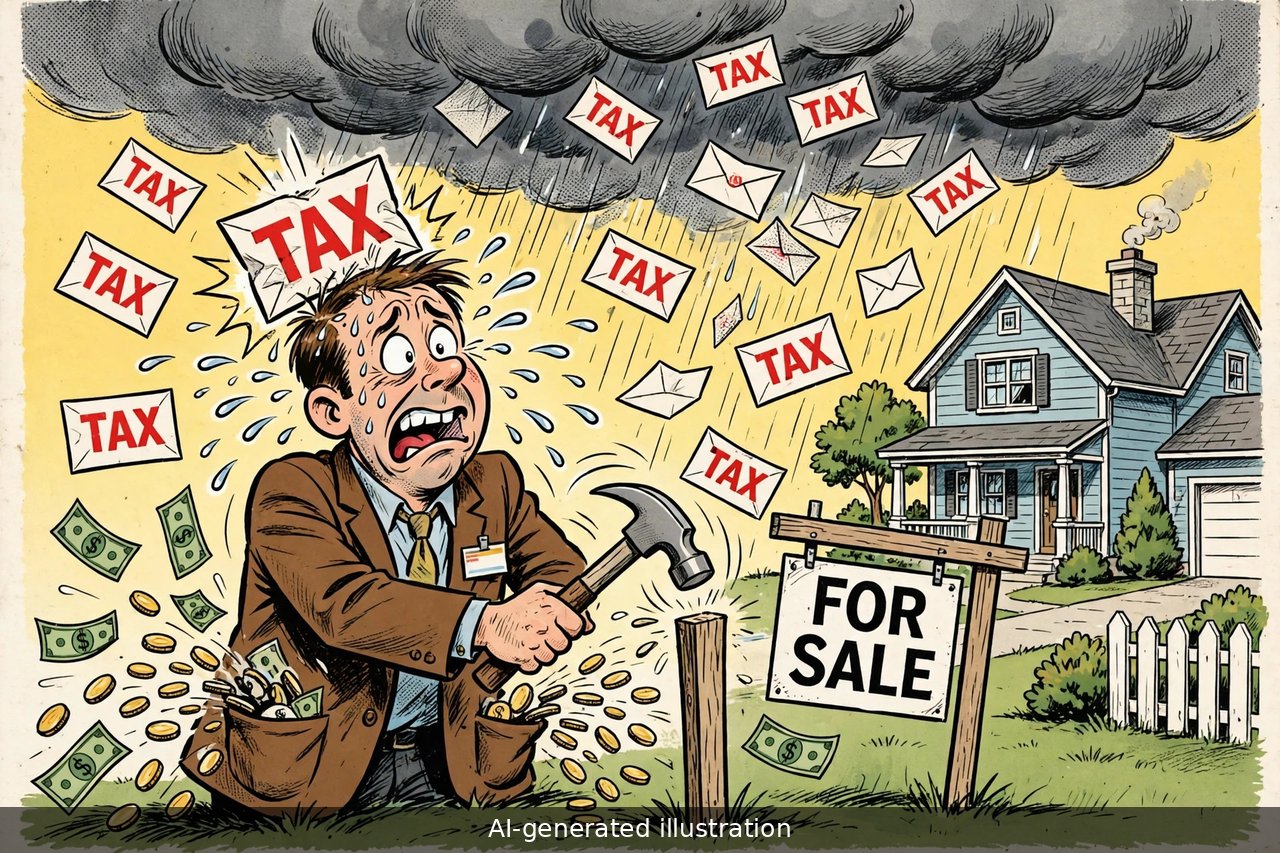
The email landed this week, and if you are a California agent, you probably read it the way I did. Your brokerage is adding sales tax to your technology fees in January. First instinct: the brokerage raised its fees again.
It did not. Your brokerage didn't raise your fees — Sacramento did.
I received the same notice from eXp Realty. It is not an eXp decision, and it is not a fee increase. It is a new California law that reaches every brokerage in the state — and, as I will get to, every small business that runs on software. Which today is all of them.
What actually changed. Senate Bill 122, signed June 29, 2026 as part of the state budget, expands California sales tax to "digital products" — prewritten software, including the cloud subscriptions (SaaS) most of us run our businesses on. For decades, California taxed software only when it came on a disk. Downloads and cloud subscriptions were not taxed. Starting January 1, 2027, they are. The tax agency's guidance is CDTFA Special Notice L-1036.
Add up your stack. This is where it stops being abstract. A working agent's month is a stack of subscriptions: the CRM that holds your client database. E-signature and transaction management. The marketing platform. Website and IDX tools. And the brokerage's own technology and cloud brokerage fees on top. None of that was taxed last year. All of it is in the taxable category now.
Run your own numbers, but here is the shape of it with round ones. Say your stack — subscriptions plus brokerage tech fees — comes to $400 a month. At 7.25%, the rate across most of Ventura County, the tax adds $29 a month, about $348 a year. At Oxnard's 9.25%, it adds $37 a month, about $444 a year. Not a business-ender. But it is real money that was not in your 2026 budget, and teams paying per seat will feel it faster than solo agents.
Why your address matters. Software delivered over the internet has no store and no shipment, so the tax rate follows the address the seller has on file for you. That is why brokerages are asking agents to confirm their address before January. In Ventura County the spread is real: much of the county sits at the 7.25% state floor, Ventura is 7.75%, and Oxnard is 9.25%. If a vendor is working from an old address, you will be charged that address's rate — right or wrong.
It is not just us. Agents are simply the first to notice, because brokerages sent notices. The same tax lands on every small business in California. The restaurant's point-of-sale system. The contractor's scheduling app. QuickBooks at the shop down the street. There is no business-to-business exemption — software a business buys for its own use is taxed the same as a consumer purchase. Streaming music and video, eBooks, and games are excluded. This is about business software.
What it does not tax. SB 122 taxes software, not services. Brokerage services, consulting, and transaction coordination are not turned into taxable items by this law. If a line on your January invoice looks like a service being taxed as software, that is worth a question to the vendor — each company is drawing its own line on bundled fees while the state's final rules are still pending.
What to do before January 1:
- Inventory your subscriptions — every tool, every seat — and confirm the address on file with your brokerage and each vendor. That address sets your rate.
- Expect the tax as its own line item starting with January billing, and budget for it: roughly 7.25% to 9.25% on top of your software costs here in Ventura County.
- Ask your vendors how they will apply it, especially on bundled fees. Charges for periods before January 1 should not be taxed.
- Check your first invoices of the year instead of assuming they are right.
- Give your CPA a heads-up now, so your 2027 numbers reflect it.
One honest caveat. The tax agency's final regulations are still being finished — the emergency rules are expected to reach the Office of Administrative Law in early December — so some details on bundled charges may still move. Watch for the final rules.
None of this is a reason to be angry at your brokerage, whichever one it is. Every brand is collecting the same tax because the state told them to. It is a reason to spend twenty minutes on your subscription list before the end of the year, while the fix is still free.
This article is general information, not tax advice. For your own situation, talk to your CPA or tax professional.
— Jorge N. DeLeon, GRI, ABR, CRB, C2EX · The DeLeon Group, Brokered by eXp Realty · 805-790-0020 · CA DRE #01148777
Sources: CDTFA Special Notice L-1036 (Sept 2026); Senate Bill 122, Stats. 2026, ch. 23; CDTFA Tax Guide for Retailers and Purchasers of Digital Products.