
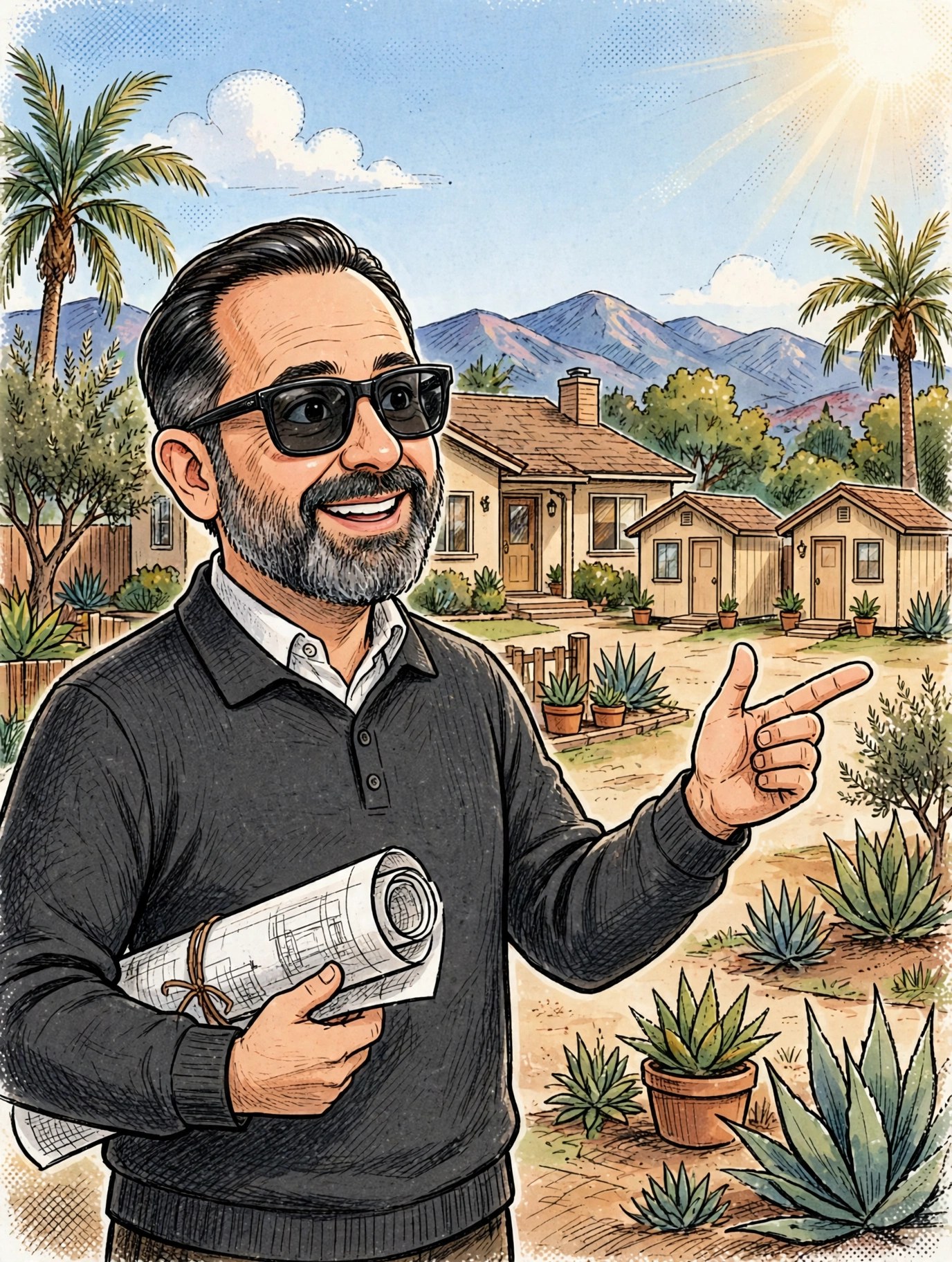
Starting January 1, 2027, California homeowners with a single-family lot will be able to build two detached accessory dwelling units (ADUs) in the backyard instead of one. A second new law lowers the impact fees on larger ADUs. Both laws were signed on September 29, 2026. Here is what they say, what they don't say, and what Ventura County homeowners should know.
What changes on January 1, 2027
AB 956 (Assemblymember Sharon Quirk-Silva, D-Fullerton) amends the state's ADU law for single-family lots. Today, state law guarantees one detached ADU, one converted ADU (for example, a garage conversion), and one junior ADU (JADU, created within the existing home). Beginning in 2027, the guaranteed detached allowance doubles from one to two.
The details in the law:
- Each detached ADU is new construction, with side and rear setbacks of no more than four feet.
- A city may cap each detached ADU at 800 square feet of living space. (Some cities, including the City of Ventura, already allow larger detached ADUs under local rules — up to 1,200 square feet — and state law is a floor, not a ceiling. Cities may be more generous; they may not be stricter for these units.)
- Height follows existing state standards: 16 feet in most cases, 18 feet near major transit or next to multistory multifamily buildings, with up to two additional feet for a pitched roof.
- Cities may not impose a minimum lot size, and may not add extra objective standards beyond what the statute allows.
- ADUs under this law must be rented for terms longer than 30 days — they are housing, not short-term rentals.
- There is no owner-occupancy requirement for ADUs. (JADUs carry an owner-occupancy rule only when they share sanitation facilities with the main home.)
- One limit worth knowing: if a homeowner builds the two detached ADUs under the new provision, the city is not required to also approve a JADU on that lot. In practice, the state-guaranteed maximum works out to the main home plus three accessory units — four homes total — in one of these combinations: a converted ADU + a JADU + one detached ADU, or a converted ADU + two detached ADUs.
SB 1117 (Senator Sabrina Cervantes, D-Riverside) addresses fees. Under current law, ADUs of 750 square feet or less pay no impact fees, and larger ADUs pay impact fees proportional to the size of the main home — charged on the entire unit. That creates a "fee cliff" the moment an ADU crosses 750 square feet. Beginning in 2027, for up to two ADUs on a lot, the proportional fee applies only to the square footage above 750.
An example from the bill's analysis: on a lot with a 2,000-square-foot home, a 1,000-square-foot ADU in a city with a $20,000 fee schedule would owe about $10,000 in impact fees today. Under SB 1117, the fee is calculated on 250 square feet instead of 1,000 — about $2,500.
Two things SB 1117 does not change:
- Connection and capacity charges (water and sewer hookup fees) follow separate rules and are not covered.
- School district fees are a separate system. They apply to new construction over 500 square feet (the 2026 Level 1 cap is $5.38 per square foot), so a 600-square-foot ADU owes school fees even though it owes no city impact fees.
What supporters and opponents say
Supporters, including the bill's author and California YIMBY (which sponsored SB 1117), argue the laws help families house aging parents or adult children, create rental income, and add homes in existing neighborhoods without new subdivisions. AB 956's author described it as a step toward addressing the state's housing shortage. SB 1117 passed the Senate 37–0 and the Assembly 70–0.
Opponents, including the League of California Cities, the California Fire Chiefs Association, and roughly 16 cities — among them Thousand Oaks — argue that state mandates override local planning, and that water, sewer, power, roads, and parking in many neighborhoods were planned for lower density. On SB 1117, a coalition of local-government associations argued the fee change disregards the cost studies that tie fees to a project's actual impact, shifting infrastructure costs onto existing residents.
What this means in Ventura County
- No local guidance yet. As of this writing, none of Ventura County's cities — Ventura, Oxnard, Camarillo, Thousand Oaks, Simi Valley — nor the County has published guidance specific to AB 956 or SB 1117. Local ADU ordinances must comply with the new state standards by January 1, 2027, and where a local ordinance conflicts, state standards apply.
- Timing matters. The laws take effect January 1, 2027, and neither bill includes a transition rule for projects already in process. A homeowner planning a second detached ADU should confirm timing with the city planning department before submitting.
- Selling an ADU separately is still the exception. State law generally does not allow an ADU to be sold separately from the main home. A separate state law (AB 1033) lets cities opt in to allow ADUs to be sold as condominiums; homeowners should confirm their own city's current status with the planning department before counting on that option.
- Cost is still the biggest factor. Southern California builders commonly cite roughly $285–$600 per square foot for a detached ADU, with total project costs often landing between about $170,000 and $480,000 depending on size, site conditions, and finishes. The City of Ventura offers free pre-approved ADU plans (700, 900, and 1,188 square feet), which can reduce design costs.
The bottom line
From January 1, 2027, a Ventura County single-family lot can hold the main home plus up to three accessory units under state law, and the impact fees on a larger ADU will be calculated only on the space above 750 square feet. Whether that pencil outs depends on the lot, the city's updated ordinance, utility capacity, and construction cost. If you are weighing what your lot can hold, start with your city planning department — and if you would like a second set of eyes on how an ADU could affect your property's value, we are glad to talk it through.
Questions about your property? Call or text The DeLeon Group at (805) 790-0020.
Image disclosure: The illustration at the top of this article is an AI-generated cartoon created for this post. It is not a photograph.
Sources: AB 956 (Chapter 791, Statutes of 2026) and SB 1117 (Chapter 809, Statutes of 2026), chaptered bill texts; Governor's signing release, September 29, 2026; Senate and Assembly floor analyses; Best Best & Krieger LLP client alert on AB 956 and SB 1117 (JD Supra); City of Ventura ADU program page; California Department of Housing and Community Development ADU permit data.
Jorge N. DeLeon, DRE #01148777 · LeighAmber DeLeon, DRE #02229171 · The DeLeon Group, Brokered by eXp Realty · eXp Realty Inc of California, Broker DRE #01878277. If your home is currently listed with another broker, or you are under an active buyer representation agreement, this is not a solicitation of that listing or agreement.